2 Months To Go: Reflections On Sewing My Wedding Dress

Did I take a 9 month break from the blog intentionally? No. In fact, I don’t think I ever really announced this on the blog but I am getting married this year! Alongside the PhD, PTVL teaching, my other job as an Analyst, the podcast, sewing, running, and everything else, I decided to sew my own wedding dress. Hubris right? Well not only that but in fact I am sewing;

  • My Wedding Dress
  • My Evening Wedding Dress (I can’t dance in a long dress, I will fall over! Plus this can be worn in the future more easily!)
  • Four Bridesmaids Dresses
  • Four Ties For Groomsmen
  • A Shirt For Adam

So it’s two months to go, and most of the above list isn’t complete; although I did reach what I think will be the final full toile of my wedding dress last night – still a couple of bits to fix but we are 99% there. Am I stressed? Well yes and no. Obviously two months isn’t a desperately long time. However I am an extremely speedy sewist so I’m not too worried about it all. My main stress until two days ago was the all of the shades of velvet I’d carefully chosen were out of stock for my bridesmaids dresses. Fear not! It’s my own fault for trying to buy it in August. Now that it’s September all the velvet is back in the shops and I’ve ordered what I need so we can get going with those when it arrives. So why am I writing this blog? Well for one thing I have steroid insomnia and I woke up at 4:30 in the morning thinking about my wedding dress sewing experience. The main reason though is that I don’t think we speak enough about sewing your own wedding dress as a project. It seems mystic and far off when the reality is that if you’ve made an evening dress, you’ll probably be able to manage a wedding dress. Nonetheless it can be a taboo subject so I thought it might be useful to share my thoughts and tips for anyone who wants to give it a go.

Top Tips For Sewing Your Wedding Dress

To be clear this is not going to be a highly technical blog about basting, seam finishes, and sewing techniques. Not only are those things radically different depending on the style of dress you choose but also that’s not really what you need to know about sewing your own wedding dress. The fact you may need to look up how to finish a seam is not what will get on your nerves. Wedding dresses are inherently emotional projects. They are also prime real estate for anyone who wants to tell you how you should be sewing your dress. Avoid those people like the plague. The tips I want to share with you are more mindset based. They are to help you through the minefield and hopefully show you by the end that it’s okay to do this exactly how you want to regardless of anyone else’s opinion.

It’s Your Dress.

This sounds glib but at the end of the day the only person wearing this dress is you and even then you’ll only be wearing it for about 12 hours. That means your priorities should be (in this order); comfort, practicality, looking beautiful. Pleasing others is not and should never be on this list. Brides look beautiful when they feel beautiful, not when other people tell them they look it. I once worked a wedding where the bride was 4’11” and as a result she had chosen a stunning 1950s style knee-length fit and flare dress. She looked radiant and it suited her to a tee. Just before she went to walk down the aisle, her mother turned around to her and said ‘oh I wish you hadn’t chosen that dress’ and the bride looked distraught. Her mother went off down the aisle with a groomsmen and I pulled the bride aside for a chat (the role of an event manager can be extremely varied) and I asked her to tell me why she’d chosen this dress. She started telling me how self-conscious she felt about her height, the fact she hates long dresses, how much she loves to dance, how her and her fiancé enjoyed going to lindyhop and swing dance classes, and how unique she felt in her dress. As she told me she became much brighter because she truly loved her dress and felt beautiful regardless of the wisdom her mum had decided to impart. It’s about how you feel in your dress and if someone says to you ‘oh I’m not sure your dress is quite you’ or ‘I would have worn X’ feel free to tell them to wear that to their own wedding or my personal favourite comeback ‘its a good job my wedding isn’t about your outfit’. If you want to feel slinky and svelte? Do it. If you want to live your cinderella dreams? Crack on with my blessing. If you want to go simple and loose? Enjoy! You generally get one chance to sew your own wedding dress, so do it the way you want to, and do it with style.

Only share your progress with people whose opinion you trust.

At the end of the day, sewing your wedding dress is a whole different ballgame to buying one. When you buy a dress you have the stress of finding something you feel perfect in, and to be clear, I’m not minimising that. Saying ‘Yes’ to the perfect dress is not the stress-free single trip that we are led to believe. But. And its a big but. Sewing your wedding dress even if you are using a pattern out of the box will still be more challenging because you have to go through the ugly duck phases where the bust isn’t right or the satin is pulling or the lace isn’t behaving, or the pattern is drafted for someone who is 6ft 4 and you need to adjust it. So as you are going through all of this there are two types of people you may want to show it to; people who sew and can give you genuine advice when you are stuck, or, very close friends or bridesmaids who have no idea how to sew and can just be your personal cheerleader. However when it comes to people who can’t sew here is a word of warning, choose someone who will just be lovely and happy that you are sewing your dress. Do not show your progress stages to anyone who is likely to say any of the following; “I don’t like that bit; why does it look so weird in x place; are you sure you want that design feature; I think it would be nicer if it looked like x; is it supposed to do that?” The progress stages are your proof of concept, your workthroughs, and what you don’t want to do is have your elation at progress dampened by people who think its rubbish because they don’t know these stages are very standard in a sewing project like this. When it comes to people who do sew, just make sure you are clear about the stage you are at and the type of feedback you would like to receive. Tell them it’s a first draft or tell them ‘I just can’t get the fit on my hips correct, can you help?’ but its important to be clear about the feedback you would actually like to receive or else we risk returning to Outcome O. So named(by me) because it turns your pride and elation into ‘oh’ and makes you not want to keep sewing.

Try on every wedding dress you can get your hands on.

A harsh truth of wedding planning whether its venue, flowers, or your wedding dress you will think you want one thing and then you will hate it. The issue is when you are making your dress its a lot of time and investment to put into something you think you will want to wear. When I first went wedding dress “shopping” or ‘our market research trip’ as my mum and sisters referred to it, I tried on every style, every colour, and realised quickly that although your wedding is the chance to wear the dress of your dreams, its also one of the few days that is totally yours. It’s for you and your partner to celebrate a beautiful life event and as a result you want to be comfortable, practical, and feel your best. It will be of no surprise to any of you that my dress is not a confection of tulle and petticoats. But! I had to try on dresses like that just to make sure it wasn’t what I wanted. I tried on the most stunning and enormous dress. It was beautiful, I felt like a princess, and in the photos I look gorgeous. In reality it was a standing still dress. It looked incredible stood on the box in the bridal shop but then you get off the box and walk around and you realise that having the turning circle of a 3.5 tonne van may not be ideal and that’s before we get to the thorny issue of trying to go to the loo. For some people that is their dream and that is brilliant! For me it would have driven me insane in about 5 minutes and I would have felt silly which is not what you want on your wedding day. I only know I don’t want that because I tried it on. So try everything. Try styles you think you’d hate. Try styles you’d never dream of. Try anything and be open to suggestions and then take a million photos. My core conclusions from my shopping trip were as follows:

  • Enormous dresses are beautiful but not for me.
  • Any dress with a corset or corselette is not the best friend of an asthmatic.
  • There is such a thing as too plain.
  • Ask your nearest and dearest to be honest with you and make sure they are on your wavelength. I picked up one dress and my sister remarked ‘it’s fine if you want to look like Glinda the Good Witch’ and she was unerringly correct. The thing is that wouldn’t have occurred to someone else but I would have realised I looked like that 5 minutes before going down the aisle so I’m glad she said it then.
  • First thought best thought. If you look in the mirror and think you look like a cake topper then move on, even if everyone else thinks you look stunning.
  • Make sure you can dance and breathe and move in the style you like.
  • Consider the cost of the fabric and the finish. My favourite dress I tried on was about 80% perfect. I liked the style as a starting point, I liked the way it made me feel, and I really liked that I probably wouldn’t need more than 4m of satin to achieve it. (Side note; the one in the shop didn’t have french seams for £1800 I would expect them on Satin?!)
  • Do not feel guilty for being fussy. You know the saying ‘measure twice, cut once’? Well when it comes to wedding dresses it’s more like a 100:1 ratio.

There are more shades of white than Dulux could dream of and that’s before you get to cream.

This may have been the part I found the most frustrating. Once you enter the world of wedding dresses white isn’t white. You suddenly get white, off-white, pure white, eggshell, ecru, blush (which is a pink type of white), and let’s not forget ivory. It is very very important than you choose the right colour. It’s also mind-numbing. Also bear in mind how colour and tone is created in a wedding dress. Particularly in more voluminous dresses the colour can be built by layer. A white overskirt and white tulle with a blush lining which would give an overall blush finish. The next joy on your plate is translating this to fabric shops who do not work to the same colour standards of the bridal industry, because NOBODY does. I went with a sort of vintage off-white. It looks nice next to my skin, it works well with the style of dress I am making, and most importantly for me, it was clearly identifiable in the fabric shop. All I’m saying with this one is mentally prepare yourself to care more about the colour white than you ever have in your life but also remember, it’s not that deep. What matters is that you feel comfortable wearing and working with your fabric. It’s not your job to sell yourself on the very specific tone of ivory blush that frankly doesn’t exist outside the lighting of that bridal shop. Take it back to basics.

It’s going to take months and you’ll still be working on it until the week before.

This is normal. This is unavoidable. You may buy a wedding dress a year out from your wedding but you’ll be in the shop 3 months before for alterations and 1 month out from your wedding you’ll still be getting any snagging done. This isn’t like any other project you will do. You will start a year out with the designs. You might even buy the fabric at this stage or go trawling through samples to find what you like. You’ll do a toile. You’ll love it. You’ll change it by a fraction and suddenly ruin the whole thing. You’ll move from messy toile fabrics to fabrics similar to your dress and the design suddenly won’t work. You’ll lose weight. You’ll gain weight. You’ll go on holiday. Life will happen. You will have deadlines that mean you have to put your wedding dress on one side for a month. Your opinions will change on how you want your dress to look and that is all natural and part of the process. I’ve had lots of people tell me I’ve left everything too late but no one else knows what too late means in your context. I don’t know if its because I am doing a PhD, which is the academic equivalent of sewing your own wedding dress, but I feel very sanguine about working through drafts and drafts for months whether its my thesis or my wedding dress. It makes it easier to know that you’ll be working on it constantly for 9 months to a year and even if you prepare and plan you will still be hemming it the week before so why stress? Which brings me on to my next tip.

Like any project, figure out how you work best.

This is starting to sound like an academic skills blog but read on I promise it’s about sewing. To be brutally honest if I had to sew my wedding dress everyday for a month I would go stark-raving mad. I’m not a little and often person when it comes to creating. Just as with my thesis I am a ‘think about it for 6 weeks then suddenly get struck by inspiration’ kind of person. I need thinking time. I need to mull. I need to consider what I like and what I don’t and crucially why I don’t like it. However this means that once I do decide what I want, I choose a day or a night (normally a night when Adam is out at Jujitsu) and just crack on for 4-8 hours. For someone else the way I work would be intolerable or frankly impossible. There are people who would love to chip away at the project every day. There are people who start their dress two weeks out. There are people who hand sew the entire thing (and to be clear those people are insane) but the point is, you have to figure out what you need and how you best work. I fully intend to go to the Southern Sewcial in October to finish off my panic sewing. I know there will be panic sewing so why not actually book in a day to do it!

Start Somewhere. Start Anywhere. Just Start.

Its daunting. I’m not going to sit here and say that it isn’t because it is. And frankly it’s supposed to be. You are preparing for a watershed moment in your life and most likely in your sewing career. It’s scary and do you know what? You’re allowed to stress. Even on your toiles you are allowed to stress about it but it’s so much more important to make some progress than none. People will build up wedding dress sewing as the be all and end all but it just isn’t. You are making a dress. You are putting a pattern together just like you do the rest of the time. If, like me, you had a couple of patterns as starting points then I recommend writing your own instructions as you go, but at the end of the day it’s just another sewing project. Admittedly the fabric is more expensive and the stakes are higher, but don’t let that deter you. Your first toile of your wedding dress is always going to be a proof of concept. You’ll love it. You’ll hate it. You’ll know what needs fixing. You’ll see the germ of your design starting the emerge. No matter what you have to start somewhere and it’s never going to be perfect the first time. My way of tackling the existential dread I had about starting? I put a 30 minute timer on and dashed out a full toile. It was basted together in rubbish acetate that cost me £4, the length of the front and back didn’t remotely match. The bust was too small. The train looked like a tiny puddle that had got caught in my sewing machine. The straps were wrong. The shape of the skirts didn’t match. But none of that mattered because I could see that my dress was in there and it would work out eventually. Think of it like a concept car. The doors may not open. None of the electrics are in it. It’s not truly a car. It’s an indication that your concept works and it gives you a road map.

Finally, remember that in a year’s time you will not care how long the seams took or how frustrating rouleau loops and covered buttons are, or how many toiles you went through, because its frankly the least important part of the day. Getting to walk down the aisle and marry your favourite person on the planet should not hinge on your dress. I would marry Adam in my pyjamas with no make-up on at a registry office at 10:00 in the morning on a random Tuesday with no one else there. It’s lovely to get to wear a beautiful dress and be surrounded by friends and family to celebrate your wedding, but never let the dress get in the way of the wedding.

P.S. If anyone, and I do mean ANYONE, decides to tell you how you could have made your dress better on the day of your wedding, have them removed from the venue.
Step By Step Guide To Sewing French Seams

At the moment I am up to my eyes in patterns tests, I have about four to complete in the next three weeks. The upshot of this is that I can’t really share what I’m sewing… HOWEVER! One of these patterns tests is a french seamed garment and it got me thinking that I really should write up and film a french seam tutorial.

Along with threading an overlocker, French seams have a bad reputation for being awkward, difficult, and generally causing issues. French seams confuse a lot of sewists out there and I get it because quite frankly they are counter intuitive and if you get them wrong you can’t really do them again.

Despite that they are actually my favourite seam finishing technique and you can use them on any project with lightweight fabrics. The only stipulation it that you need to be able to iron the fabric or at least press it down with a clapper.

To help other sewists love french seams as much I do I’ve put together a handy guide to take you through the process step by step!

Step By Step Guide To French Seams

Step 1: Workout your Seam Allowance split

Step 2: Sewing First Seam WST

Check your seam allowance and work out how you are going to split it if not indicated in the pattern. For this pattern I am using a 2cm seam so we are sewing both seams at 1cm. However if you are working with a standard 1.5cm seam then I normally split it as 1cm then 0.5cm(in line with the inside line of the presser foot.

Step 2: Sew your first seam

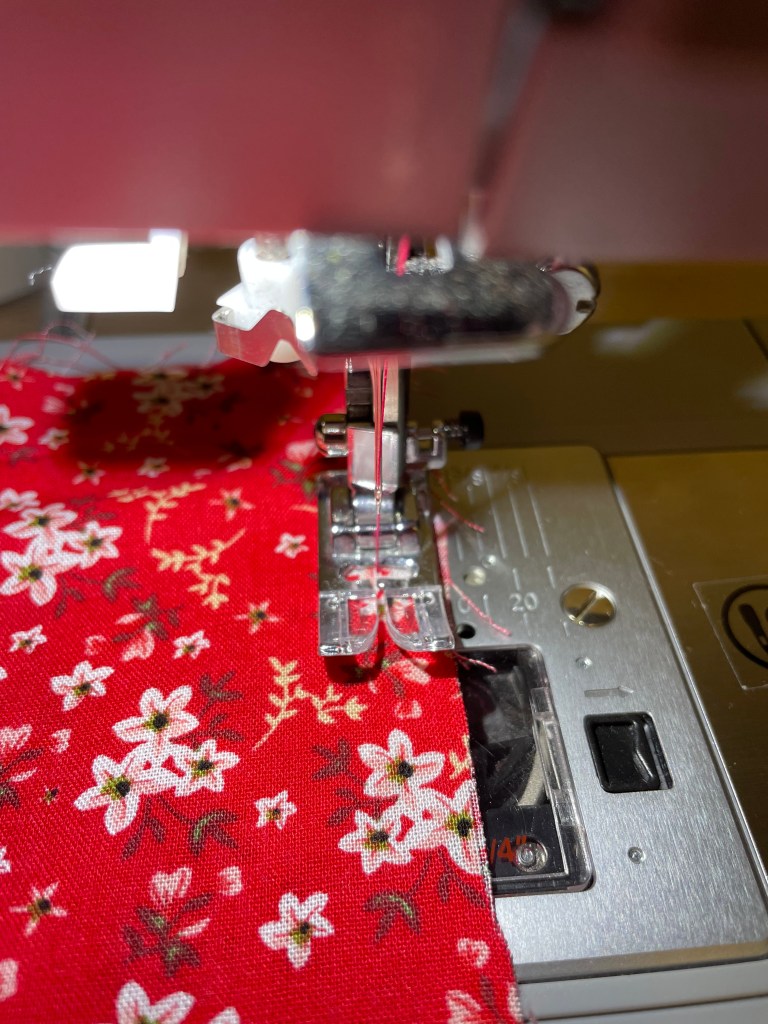
Sew your first seam with the fabric Wrong Sides Together. It feels very strange but you should end up with your seam on the outside of your garment.

For my garment this seam will have a 1cm allowance but remember to check what you should be working to on your project.

Step 3: Trim off the excess

Trim the volume of the seam down as close as you dare to the stitching line. Be very careful when doing this that you don’t actually snip the stitches or catch any of other sections of the garment in your scissors.

Step 4: Flip the seam so that the fabric is now Right Sides Together

When you do this make sure the press the new seam so you get a lovely crisp edge and secure what will now be the inner line of stitching enclosed in the second seam.

Step 5: Sew your second seam enclosing the first one

Sew your second seam as you would usually with the garment Right Sides Together. Again remember to check what seam allowance you should be using for my project its another 1cm seam allowance however yours might be 0.5cm at this stage. Remember that this seam should completely enclose the first seam. If you have fabric from the first seam poking out through the second seam then you need to trim the first seam down even further.

After sewing give your seam a good press. When you turn your garment through to the right side it should look like a perfectly normal seam with nothing poking through.

Secrets of French Seaming

  • You can split the seam allowance however you like! You don’t have to do it in the exact measurements supplied by the pattern as long as the seam allowance amount is correct at the end. I tend to use the 2/3 1/3 method. E.g. When I’m doing a 1.5cm french seam regardless of what the pattern says my first seam is 1cm. Then I trim and flip and my next seam is 0.5cm.
  • Iron at every stage! It helps set the stitches and secures every stage making an overall stronger seam.
  • French seaming sleeves is not nearly as complex as you think it’s going to be. It’s award but I promise it isn’t difficult and the result is brilliant!
  • When working with chiffon or similar very lightweight fraying fabrics I strongly recommend finishing the edges within the seam so there is less chance of them fraying and ripping open. E.g. I stitch together Wrong Sides Together, trim, then I finish what is left with a zigzag stitch, then I flip through and sew the final seam with fabric Right Sides Together.
  • Move all the other fabric out of the way before trimming your first seam – this is the number one way to cut a huge hole in your beautiful new make completely by accident. The worst thing is? You won’t even realised you’ve done it until the end when you turn your new make right side out.

That is my tutorial for beautiful French seams! My biggest piece of advice? Don’t overthink it. Take it slow and follow the steps and you will get there.

French seams are my absolute favourite finishing technique and as I’m doing a lot of them today it felt like a nice to time to write about them. I don’t write up tutorials very often so if you enjoyed this blog and want to see more then please do let me know in the comments and share it with your sewing friends.

Make Do And Mend: Looking After Your Me-Made Wardrobe

When I made the choice to reduce my consumption of fast fashion, I also signed up to another pledge. I committed to looking after my existing ready-to-wear wardrobe.

My focus has shifted from trends to joy. Joy of fashion. Joy of garments. Joy of sewing.

I want to achieve something with my me-made wardrobe that many fast-fashion brands do not, and make my garments last.

Fast fashion brands like Shein, Pretty Little Thing, and Boohoo churn out poorly made clothes designed to be worn, wear out quickly, and throw away after six months so that you can buy into the next big trend.

Each piece of clothing is a stepping stone to the next piece and very little consideration is given to the longevity of our wardrobes.

With me made garments we invest time and energy. We put care into every step and create something that we want to wear and we look after it.

However sewing doesn’t mean throwing out your existing ready-to-wear wardrobe, I have RTW clothes that have lasted over 10 years with careful washing and conscious approach to their care.

Caring For Your Wardrobe

A quick test to see if you look after your wardrobe. Do you know what these symbols mean? Chances are you’ve seen them as you hang your clothes out or briefly as they disappear into the washing machine. I know that I didn’t understand them for years. Sometimes I still get confused!

These symbols describe how you should care for your clothes and yet most of us don’t understand them or just don’t read them. However they are the key to caring for our RTW wardrobes. To tell us what to do and crucially what not to do! What temperature to wash at. Whether or not it can be tumble dried. Even sometimes what temperature your iron should be.

Following these symbols prolongs the life of garments and therefore helps us to consume less. This article is not here to berate you, I’m not trying to tell you off because honestly who has time or energy for complex garment care.

When we do get to the point where mending is required, when a button falls off, a zip breaks, seams fray and split, we are more likely to throw the garment away or take it to charity than we are to fix it. The reality is that that is how we’ve been conditioned to engage with clothing and the fashion industry. But we don’t have to. We can choose to look after our clothes properly, we can even refashion our clothes to make new garments we will love for longer.

The Joy Of Mending

Put your hand up if you honestly like mending things. Whether thats for yourself or for others. No? No takers? Exactly, mending is a sewing chore.

It’s not fun, it’s time consuming, irritating and frankly most of us would rather be doing anything except sewing a button back on. Which makes it even more annoying that mending is a crucial skill and one that will make your clothes last almost forever.

Regardless of how boring mending can be it truly is a superpower held by sewists and dressmakers and one we must use. We can do mending easily ourselves if we put our minds to it. We have the knowledge to insert a new zip or fix a fraying hem. If you’re lucky you’ve got a sewing machine like mine that will attach buttons for you with no hand sewing involved!

My Top 5 Garment Mending Tips

  1. Don’t leave it. If you notice a seam starting to fray, a button becoming loose, fix it then and there.
  2. For patching tiny holes in garments or reinforcing newly sewn-up rips try adding a bit of iron-on interfacing
  3. Don’t be scared to refashion. If you’ve got a garment that has a huge rip or hole, why not considering making it into something else so it can return to your wardrobe.
  4. Consider visible mending with embroidery. It’s a fun way to customise a garment and add a bit of personality.
  5. Set aside one day a month to tackle the mending and refashion bag. Grab a cup of tea, stick something on the radio or the TV, and get sewing!

10 Ultimate Truths of Sewing

Whether it’s the white knuckle ride of bobbin chicken when you know you have none of the matching thread left in the house, the infuriating second side of your zip, or the soul crushing realisation that you’ve just cut a huge whole in the middle of your garment when trimming a french seam, we’ve all been there.

One of the wonderful things about the sewing community is that we all have these experiences. Whether you’ve been sewing for 5 days or 25 years you will have to unpick something, you will attached a sleeve the wrong way around, and you break a sewing needle so badly it’s left looking like a paperclip (just me?). These things happen.

As an experienced sewist I’ve learnt that there are certain fundamental rules of sewing and it is wise to prepare. For example, never buy only one spool of a very specific thread colour, get a couple; check your bobbin level BEFORE starting a very long seam; and never ever put your seam ripper away. In the same way that when you call someone from IT when your computer breaks only to find it works when they are stood there. While your seam ripper lies next to you everything is fine. The minute you put your seam ripper away, you send a cosmic signal to the universe asking to unpick half of your garment and put a sleeve in wrong side out. It’s pure hubris and I have to stop doing it.

To get back into blogging I thought I would pull together my list of ultimate sewing truths, the rules at the heart of the thread-iverse. I should say, there will be someone who takes this too seriously so for the sake of a small minority(who always make their toiles), this post is based on my experiences of sewing and is also just a bit of fun.

10 Ultimate Rules of Sewing

  1. Even the most accomplished dressmaker has to unpick things
  2. The one time you don’t follow the fabric allowance on the pattern is the time you will actually need it.
  3. One side of your zip will be perfect first time, the other side will take 17 tries
  4. It is easier to get a degree in Nuclear Physics than it is to work out the correct overlocker tension first time
  5. No one actually changes their sewing machine needle every 8 hours
  6. If your thread is going to run out, it will do it in the middle of topstitching
  7. No matter what is in your wardrobe, you will find yourself sewing a new dress hours before you have to leave
  8. Toiles are both incredibly important and stunningly dull, as all the most useful things are.
  9. Whenever you think you’ve sewn something perfectly first time, you will find your bobbin ran out at the beginning and you have to do it all over again
  10. Always get two more buttons than you need. An extra for when you inevitably miscount the number you needed in the first place and one to go in the buttonhole foot after you’ve attached the rest without thinking.

This very silly and fun post signals that I am indeed back to blogging regularly. I will write a proper life update so you lot can know what I’m up to, where I’ve been, and where I’m going. But! In the meantime, let me know what you would add to this list in the comments below! I’m considering having it put on a tea towel.

How To Choose Your First Overlocker

To the uninitiated Overlockers are baffling and choosing one even more so. Until this year I really didn’t need one, however, 2020 saw my sewing advance more than it has since I was 17 and now I’m looking for greater challenges as well as the ability to finish my seams with ease. In particular I want to tackle activewear and swimwear for which an overlocked is essential. After a lot of thought and a long phone conversation with my mum as we trawled through websites, we finally chose my first overlocker and its on it’s way to me now! Once I mentioned this on instagram I had loads of messages asking how I had chosen it, what specifications I looked for and if I had any advice on choosing an overlocker. I am by no means an expert however with the guidance of my mum, who is a bit of a sewing expert, and A LOT of web searching choosing my first overlocker was pretty painless. Now I’ve got a few tips and tricks that should help you to find your first overlocker easily.

Why Do You Want An Overlocker?

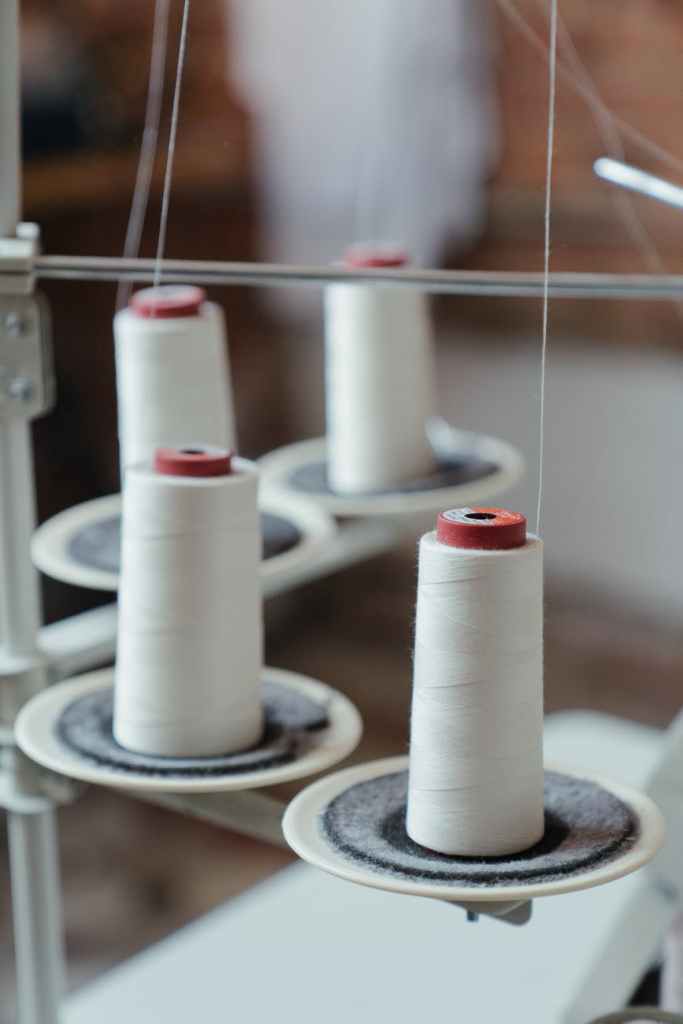
Photo by cottonbro on Pexels.com

This is crucial. It can be easy on social media to convince yourself that you need a new piece of equipment just because other people are using it and using it to great success! (ahem…cricut machines) So when you start your overlocker purchasing journey its important to take a moment before you begin browsing, sit down with a piece of paper and answer these three questions:

  • What do want your overlocker to do?
  • What are you going to use it for?
  • What do you want your overlocker to do that your current machine can’t?

It is vital to understand what you wish to accomplish with your Overlocker that you can’t do with your current machine. Further more consider your sewing space, can you store your Overlocker easily? Once you have answered these questions then it will be easier to direct your search when it comes to individual models and specifications. After all you may want a more lightweight model if you’re just sewing Lycra whereas if you want to finish any fabrics then you may need a heavier weight machine. My choice rested on certain factors. I want to be able to finish off any garments regardless or weight or bulk as I’m awful for finishing seams. I want to sew with lycra and stretch to make my own activewear and yoga leggings which my current machine cannot do. So these were my criteria when I started to look at overlocker models.

What To Look For In An Overlocker

When it comes to specifications you do get what you pay for which is why one of my first pieces of advice is that if you are looking to go upmarket, wait for sales and offers as any reduction will help! However, as with sewing machines, you don’t always need all the spec’s on the fanciest of machines so if you are on a budget it’s a good idea to whittle it down to the base set of specific requirements you have and then anything you find above those but within budget is great. Also its a good idea to purchase from a well-known brand if you need to get parts, attachments or get maintenance done.

What Specifications Should You Look For?

Photo by cottonbro on Pexels.com

Overlocker specifications can initially feel baffling. Even for some who is very comfortable with seeing terminology, overlocker have a whole new layer of assumed knowledge so before we discuss machine specifics, I’m will attempt to demystify the specification categories.

  • Adjustable Stitch Length – Its important to make sure that you can alter stitch lengths and tension for different fabrics. Most machines can do this but if you are looking for a cheaper machine do make sure that you have this functionality.
  • Number Of Thread Lines – e.g. 2, 3 or 4. It’s a good idea to make sure your machine can do three and four thread overlocking again to give you options and the greatest functionality when you sew.
  • Differential Feed – The differential feed is the way the machine feeds the fabric through, similar to a walking foot. It’s a good idea if this is adjustable as it means you can adjust for different fabrics to make sure you’re not stretching or gathering fabrics, or that you can do so purposefully.
  • Presser Foot & Knife Options – an extra high presser foot lift and a larger knife is useful when working with bulky fabrics.

Beginner Machine Options

Just for transparency, I have no affiliate agreement with any of these brands. These are just some of the machines I looked and held in my shortlist before choosing my overlocker.

Good Beginner Options

  • Janome 9300DX – this model is very compact and provides good value for money. Sews up to 1500 stitches a minute, with 3 or 4 thread overlocking, adjustable cutting and seam width. Whatsmore this machine, unlike others, uses standard sewing machine needles so very easy to care for and replace needles. Janome also has great access for maintenance and spare parts as John Lewis stock their whole range.
  • Singer Overlock 14SH754 – This model was my initial choice as its very user friendly and a wonderful entry-level option with colour coded thread lay-in lines, with 2-3-4 threading and a range of hem and stitch options. The only thing to be aware of with this model is that it is quite lightweight so may not be suitable for heavy fabrics that being said, if you’re happy finishing woven seams on your sewing machine and just want this for lightweight stretch projects then it would be great!
  • Brother M343D – When I first mentioned on instagram that I had chosen an overlocker I got lots of messages wishing me luck and asking what model I had got. I would say about 90% of the people I spoke with had bought this model and love it! It’s a fantastic entry level machine, well priced and able to handle the majority of projects and fabrics with 3 and 4 stitch options as well as a handy tension release disc and colour coded lay-in lines. The only note on this machine is that it can be a little noisy so make sure you are overlocking in a space where noise is okay!

These were my shortlist and honestly it would have been one of these three except for the fact that Singer had a sale on so I went a little more upmarket! My new model is the Singer 14HD854 Heavy Duty overlocker, as used in the costume department for Dancing on Ice, so you know its good for lycra and stretch. Its got coloured coded lay-in lines, an extra high presser foot, it does 1,300 stitches per minute and it has a much larger knife and a heavier motor to get through any fabric you care to throw at it. I’m so excited for you to see my beautiful new overlocker when it arrives and rest assured there will be a full introduction blog and vlog!

I hope this post has been a helpful guide for purchasing your first overlocker and has illuminated one small corner of the overlocking world for you! Let me know in the comments below if you found this post helpful and I’ll see you guys next time.

5 Top Tips For Using PDF Patterns

Happy Thursday everybody! Today is the last day of my annual leave so I’m sat on the sofa doing some life admin and watching the Bourne Supremacy and I’m about to assemble my Helen’s Closet Luna Tank pattern. If anything that last few days have made me realise that I really need some proper annual leave to just do nothing! However it has given me the chance to start on a very big project as well as film a few YouTube bits and reflect on a part of sewing I had never engaged with prior to this year which is PDF patterns.

Initially I thought that PDF patterns were irritating because you have to print and assemble them at home however as I’ve started sewing more often and more complex garments I’ve realised that if there is one thing I hate more than assembling PDF patterns its tracing from pattern sheets. Now tracing from pattern sheets with multiple patterns is fine, its one of those necessary evils but tracing from a tissue paper pattern is a step too far and honestly I’m starting to prefer if not outright love PDFs. I know there are lots of people out there who have never used a PDF pattern so today I’ve going to take five minutes to explain why they are awesome and give you five quick tips on using them to make your PDF pattern life simple.

1. Cut Off The Corners

This is a trick I picked up on instagram and I honestly cannot remember for the life of me where I saw it first but whoever first thought of it, you are a stone cold genius. One of the most frustrating aspects of PDF pattern assembly is cutting off the margin edges of each page and trying to line them up perfectly. However 99% of the time there is a rectangle around the pattern itself to indicate what is pattern and what is just page. So if you just neatly clip the corners of each page you can then overlap the pages and line up the external rectangle et voila! One pattern constructed in half the time and its a lot easier to tape because you aren’t trying to tape two raw edges together. Haven’t tried it before? Try it now and thank me later.

2. Use Pattern Weights

There are few things more frustrating in the world that carefully lining up you pattern pieces, extending your seletope only to find one of the pieces has somehow moved out of line. Now apologies if this sounds obvious but I genuinely didn’t think about it until the other day, use pattern weights to the fixe the pages in place then tape and move on. It makes everything so much simpler and while its more effort to get your pattern weights out it cuts down the frustration that seems to be so synonymous with PDF patterns.

3. Have A Printing Day

If like me you don’t have a dedicated sewing room or office space with all your equipment laid out then chances are you are getting out your printer just to print your PDF patterns. In this case it can be hard to work up the motivation when just buying the pattern means you have it physically. My top tip in this case is to have a printing day, if you can save up a few PDF patterns then put on a movie, get your printer out and print them all in one go. If you want to you can even assemble them at the same time but if you’re anything like me one of the biggest hurdles is just getting them printed out.

4. Check If There Are Layers

These days pattern designers are putting more and more effort into their PDF versions and many patterns now have a layers function. This means that you can isolate down just your size and print that, making cutting out a pattern with over ten sizes on the sheet a lot easier from the get go. Just a note, if you are a MAC user then you will need to use Adobe as preview doesn’t work.

5. Get It Printed Professionally!

Sometimes you may not feel like assembling a PDF pattern when its over 50 pages which is completely fair. This is why there are wonderful people out there who will do it all for you! If it’s a big or complex pattern I just pay for it to be copy shop printed. I use Natasha from Pattern Printing Girl who can be found on instagram and facebook who is cheap and speedy! There are also businesses such as The Foldline or NetPrinter who will print and send to you just be aware that some printers may have a minimum order of A0 sheets.

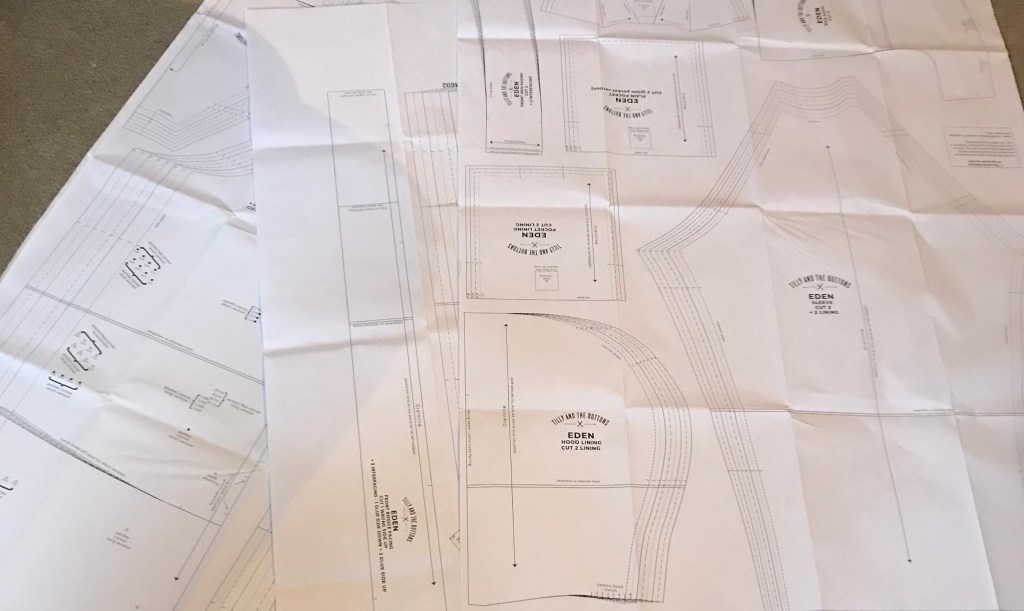
Three A0 Pages for my TATB Eden Coat!

One of the fantastic aspects of PDF patterns to me is that you always have the original meaning you can print it and cut it out as many times as you want without ruining the original. Plus you can grade between sizes so easily, you can even draw all over it if you need to, it gives you the freedom to make as many mistakes, edits or adjustments as you need. While there absolutely is a place for paper patterns and I do love the pattern envelopes sometimes its nice to have the pure freedom of cutting into a pattern and not having to worry.

Do you have other tips for working with PDF patterns? Let me know in the comments below!

Sewing Essentials For Beginners

Sewing can be a mystifying world, the language, the equipment and even the space required can feel like a barrier. Today I want to talk you through my essential sewing equipment and talk about starting.

Sewing is an interesting hobby as while most of us start with the same basic ingredients it is possible to create wildly different garments or create the same effect using entirely different techniques. The world of sewing is awash with hacks, tricks and tips for all levels of sewers. On top of that everyone’s sewing space looks different. Some people have a room to themselves some people make do with the Kitchen table. Even the language of sewing can be mystifying to a beginner so below I have unnumerated my basic essentials and what I work with on a daily basis. What is important is there is no one single formula for sewing.

If you are still look at me going, “yes but where do I start?”, I have listed what I consider to be my sewing box essentials that I can’t do anything without. Over the years I have built up my own equipment store purely based on things I actually like using and make me better rather than panic buying fancy equipment that I wont ever feel confident using.

  • Sewing Machine (Obviously)

This is my little red sewing machine, a John Lewis JL110SE, bought in 2015. Until then I used my mum’s Janome machine. I am currently saving up for a new one next year as this one won’t really do denim or thick fabrics such as wool. However this machine is an ideal starting place as it will do about 90% of the things you need it to do as an experienced sewer and 100% of the things you need to do as a beginner. Honestly I wouldn’t be thinking about getting a new machine but I used one of the Pfaff Quilting Machines on a sewing course and I fell in love and would now like a machine with some of the automatic features.

  • Quick Unpick

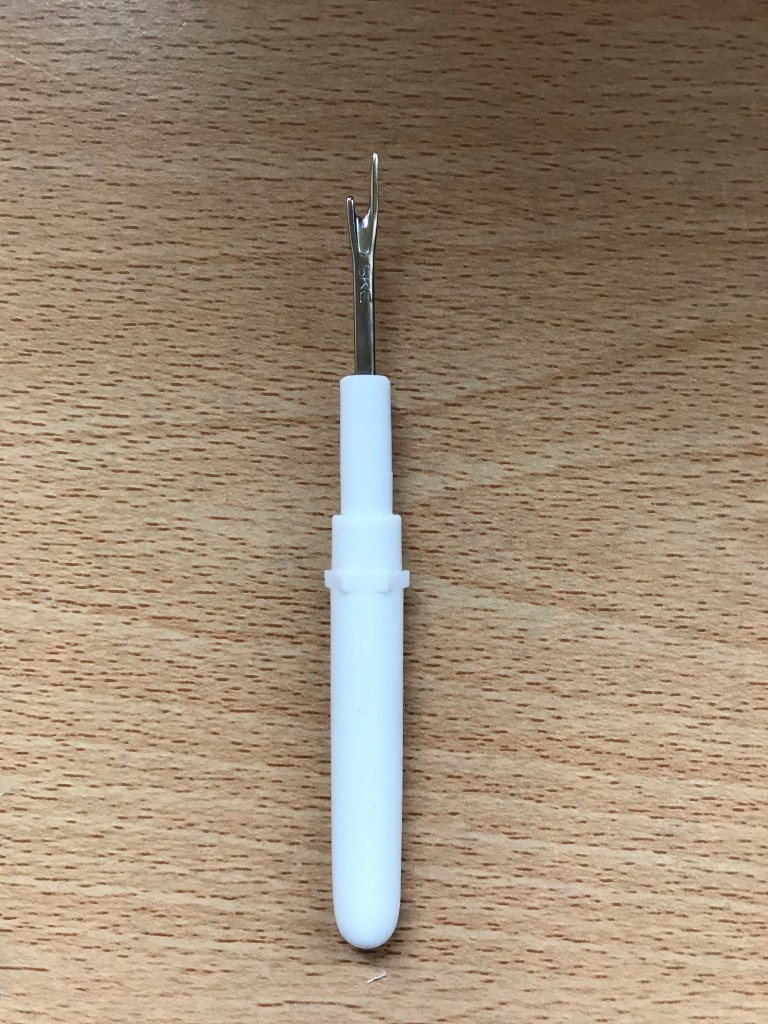
The dressmaker’s best friend! Apart from a needle and a sewing machine the quick unpick allows you to fix all of your mistake and re-do a technique again and again until you get it right. A quick unpick costs almost nothing but I don’t think I have gone a single day without using one since I started sewing, which may be an indictment of my sewing more than anything. Its one of the more wonderful things about sewing that you can fix your mistakes pretty easily in most cases.

  • Dressmaking Pins & Pin Cushion

Here is my gorgeous little pin cushion that my mum got me when i first started sewing. One of my favourite things about it is that has a band underneath so I can wear it on my wrist while I’m pinning. Especially good when working on something big or on mannequins. In terms of pins everyone is different. Some people use pins when cutting out patterns, some pattern people just use pattern weights but pins are nearly always used for seams, hems and fabric to fabric work. The only time I’ve not used pins was when making a bra because the fabrics are so fine, fiddly and sheer that you don’t want to make any holes.

  • Tailors Chalk / Pencils

Everyone transfers marks from patterns differently. Personally I favour dressmaking pencils, can you tell which one I use more? I transfer marks through with these on the wrong side of the fabric and then they wash off afterwards which is great. For fabrics that you don’t want to draw on you can use a pattern wheel which is a little spikey wheel, that looks a bit like a cowboy’s book spur, but allows you to imprint lines such as darts on to the fabric without drawing or marking it in any other way. The usefulness of this will depend on the fabric you are using but I found it helpful on lighter fabrics. The pencils have been with me for a lot longer and are definitely my favourite method.

  • Fabric Scissors

In the context of sewing, I really don’t think its possible to have too many pairs of scissors. I have a weird love for sewing scissors because they are just so sharp and effective and there are so many different types. Below is my current collection of scissors including pinking shears, fabric scissors, regular scissors and embroidery scissors and a small Stanley knife for button holes and very fiddly cutting out.

  • Steam Iron

I wont insult you with a picture of an iron because hopefully you all know what a steam iron looks like. I hate that this has to be on the list as I’m an extremely lazy ironer but ironing is absolutely central to sewing. Ironing at every single stage of the process is vital so you have to make sure you have a good iron to hand. My iron is slightly terrible so I will be purchasing a new one as soon as I can! (Any recommendations please put in the comments below)

These are the most basic but essential items that are central to sewing if you’re looking for a beginners list of equipment. What’s in your sewing essentials toolkit?